Basement
Basement leak repair in Roswell
A leak is water arriving at one place you can point to. Fixing it is smaller work than waterproofing a whole basement, provided the spot is found correctly.
You talk with an independent local waterproofing company. Roswell Crawl Space is a referral service and does none of the work itself.
The five places a basement wall leaks
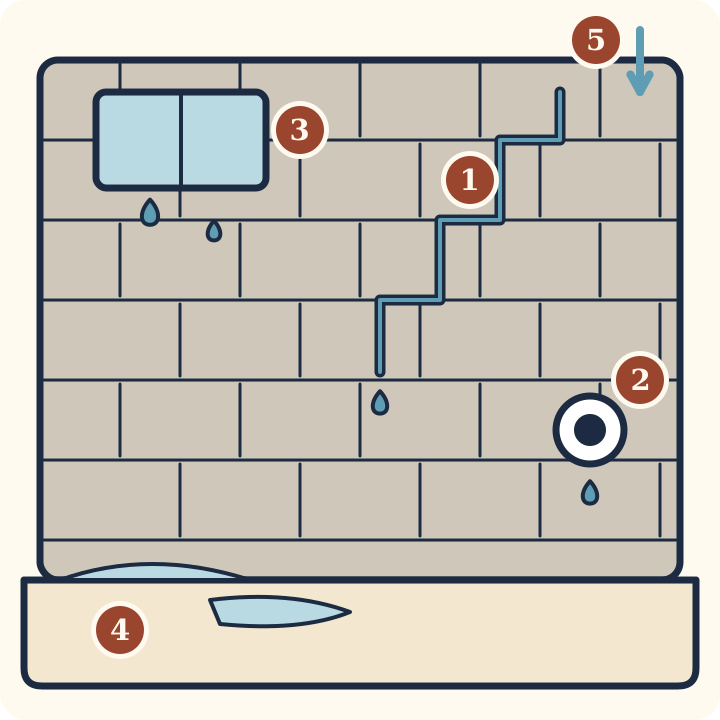
- A crack. Straight in poured concrete, stepped along the mortar in block.
- A pipe or cable opening. The gap around a water line, sewer pipe or conduit.
- A window and its well. A well that fills because its drain is blocked or missing.
- The wall-floor joint. A seam that was never sealed and cannot be.
- Over the wall. Soil or mulch piled higher than the masonry, so surface water runs in.
Each leak has its own repair
| Where it leaks | What is usually done | Worth knowing |
|---|---|---|
| Crack in a poured wall | Resin is injected from inside to fill the crack through the wall's full depth. | No digging. Small ports are set along the crack and the resin is pumped in through them. |
| Stepped crack in block | The joint is sealed, and water inside the hollow blocks is let out at the base into a drain. | Block walls hold water in their cores, so a surface patch alone tends to fail. |
| Pipe opening | The gap is cleaned out and packed with a sealant that stays flexible. | If the pipe itself drips, that part is a plumber's. |
| Window well | The well is cleared, given a working drain and often a cover. Soil is regraded around it. | Leaves packed into the well are a common cause. |
| Wall-floor joint | An interior drain along that wall. | Caulk here lasts until the next heavy rain. |
| Over the wall | Soil and mulch are pulled back and the ground reshaped to fall away. | Often a small job with a shovel and a rake. |
Pin the leak down before you call
Note when it leaks. During the storm, hours after, or with no rain at all. Note where the first drop appears, which is not always where the puddle ends up. Dry the wall, stick a strip of masking tape below the suspect spot and see where the tape gets wet first.
Then walk outside to the same point. A downspout, a low patch in the bed or an overflowing gutter directly above the leak is very often the reason it leaks there and nowhere else.
When it is not a waterproofing job
A leak that runs in dry weather is plumbing. So is water around a water heater or under a bathroom.
Inches of water across the floor today need a water damage company to pump and dry the room. Call about the leak itself once the room is safe.
Cracks that are wide, growing or running sideways along a wall that leans inward let water in, but the cause is movement. A foundation repair company or a structural engineer should see those first.
Ask the company
- Where exactly is the water getting in, and how did you confirm it?
- Is the crack repair meant to seal out water, add strength, or both?
- What happens if the same crack leaks again? Is that in the written warranty?
- Is there an outside cause I should fix so the repair is not fighting it?
Leak repair questions
Can I seal a crack myself with hydraulic cement?
It can slow a leak for a while. A rigid plug on the surface tends to work loose as the wall moves with the seasons, which is why injected repairs fill the crack right through.
The crack is hairline. Does it matter?
Thin vertical cracks in poured walls are common and many never leak. One that shows a stain or dampness is letting water through and is worth sealing.
Is a leak sealed from inside or from outside?
Most single cracks and pipe openings are sealed from inside with no digging. Outside work is kept for causes that sit outside, such as a window well with no drain or soil heaped against the wall.