Outside
Yard drainage and French drains in Roswell
Every gallon kept away from the wall is a gallon nobody has to pump. Drainage work in the yard is often the first step for a wet crawl space or basement, and sometimes the only one needed.
You talk with an independent local waterproofing company. Roswell Crawl Space is a referral service and does none of the work itself.
What a drainage problem looks like
A strip of lawn that squelches for days after rain. Mulch washed into a fan across the path. A downspout that empties onto a splash block six inches from the foundation. A neat channel worn into the soil where water has chosen its own route, usually toward the house.
Clay soil makes all of this worse. Water soaks into clay slowly, so it runs along the surface or sits where the ground dips.
Often tried first
Slope and downspouts
Reshaping the ground and piping roof water away costs less than a drain and fixes many yards on its own.
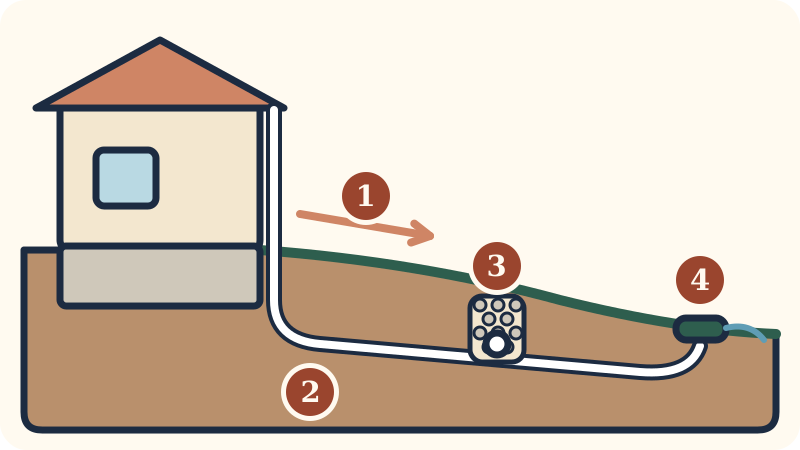
- Graded soil. The ground falls away from the wall so surface water leaves.
- Buried downspout line. Solid pipe carries roof water underground, past the wet area.
- Trench drain. Where water still collects, a French drain crosses its path.
- Outlet. The pipe ends at a low point on your own lot where water can spread out and soak in.
Below the surface
Inside a French drain
A French drain collects water that is already in the ground. It has to slope, and it has to end somewhere lower. A trench with no outlet is a long, narrow pond.
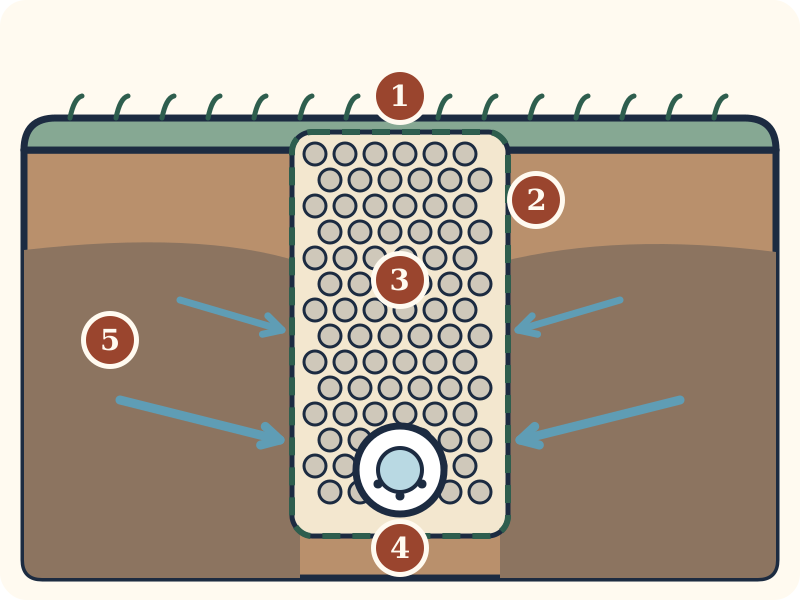
- Surface. Finished with turf, or left as open stone where water needs to enter from above.
- Filter fabric. Wraps the trench so fine soil cannot wash in and clog the stone.
- Washed stone. Gives water an easy path down to the pipe.
- Perforated pipe. Laid with a steady fall so it carries water to the outlet.
- Wet soil. Water moves sideways into the trench because the stone is easier to pass through than clay.
Where the water ends up
On your own land, at a spot where it can soak away or run off without harming anyone. Sending it onto a neighbor's lot starts disputes that outlast the drain.
In Roswell, do not pipe into or fill a drainage ditch or creek. The city treats dumping into local waterways and ditches as a code violation, and asks to be told about unapproved filling or rerouting. Work near a stream may also fall inside a protected buffer. The local guide lists who to ask.
Before the trench is dug
Contact Georgia 811 or make sure the company has. A dig ticket goes in at least three business days ahead, and the status should be checked before digging starts. The utilities mark their own lines only. Sprinkler pipe, low-voltage lighting cable and an invisible fence are yours to point out.
Tree roots are the other hazard. A trench cut close to a mature tree can kill it over a few seasons. Ask how the route avoids the root zone.
Ask the company
- Would regrading or longer downspouts solve this without a drain?
- How much fall will the pipe have from one end to the other?
- Where is the outlet, and what does it look like?
- Is the trench lined with fabric, and what stone goes in it?
- Are downspouts kept on separate solid pipe so they do not flood the perforated one?
- Who repairs the lawn and any irrigation lines that are cut?
Yard drainage questions
Is a French drain the same as the drain around a foundation?
Same idea, different place. A footing drain sits at the base of the wall, deep down. A yard French drain is shallow and intercepts water before it gets that far.
Can downspouts empty into the French drain?
They should have their own solid pipe. A roof sheds a great deal of water in a storm, and putting it into a perforated pipe pushes it back out into the soil you are trying to dry.
My neighbor's runoff crosses my yard. What can be done?
A swale or drain on your side can catch it and steer it past the house. If the water comes from a street or a city pipe, the local guide explains who to call in Roswell.