Start here
What are you seeing?
Start with the symptom, not the repair. Pick the row that looks like your house and see which job it leads to.
You talk with an independent local waterproofing company. Roswell Crawl Space is a referral service and does none of the work itself.
Where the signs show up
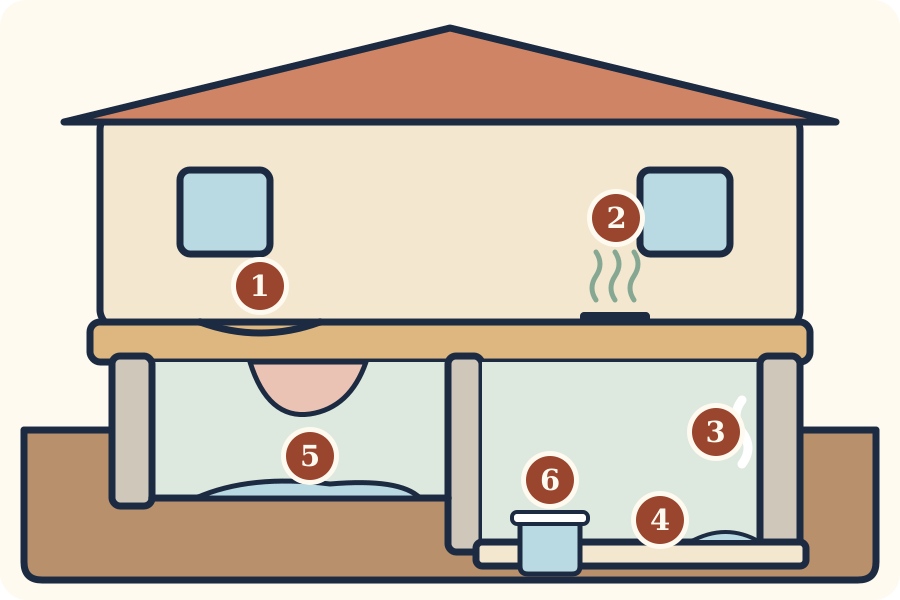
- A dip or soft spot in the floor over a damp crawl space.
- A stale, earthy odor that is worst at the floor vents.
- White powder or peeling paint on a basement wall.
- Water on the basement floor along the foot of the wall.
- Standing water on the crawl space floor.
- A sump pump that keeps switching on.
Sign by sign
Musty smell upstairs, worse in summer
Much of the air on your main floor has come up from below. When the crawl space is humid, wood and insulation down there grow mold and the smell rides up with the air.
Floors that feel soft, bouncy or cupped
Joists and subfloor that stay damp lose stiffness. Hardwood boards cup when their underside is wetter than their face. The wood needs drying before anyone decides what to replace.
Insulation hanging down under the floor
Fiberglass batts hold moisture like a sponge. Once heavy they sag and fall. Putting new batts into the same damp air repeats the failure.
Standing water under the house
Look at where it sits. Along one wall suggests a downspout or the slope of the yard on that side. In the middle suggests groundwater or a plumbing leak.
Water on the basement floor after a long rain
A wet line where the wall meets the slab means soaked soil outside is pushing water through that joint. Paint and caulk do not hold it back.
One wet spot on a basement wall
A single crack, a pipe that passes through the wall or a window well is letting water in. This is often a smaller, targeted repair.
Damp walls, no visible water
It may be seepage or it may be humid air condensing on cool concrete. A piece of foil taped to the wall tells you which in a day or two.
White, chalky powder on block or concrete
Salts left behind when water passes through masonry and dries. The powder is harmless. It proves water is moving through the wall.
A sump pump that will not shut off
Either a great deal of water is arriving, or the pump is short-cycling because of a stuck float or a failed check valve. Both deserve a look before the motor burns out.
A soggy strip of yard beside the house
Rain is not leaving the lot. If the wet strip touches the foundation, that water is on its way under the house.
When this number is the wrong call
Water that is standing in a finished room today needs pumping and drying now. That is a water damage company. A pipe that has burst or is spraying is a plumber, after you shut the main valve.
A wall that leans, bulges or shows a crack you can fit a coin into is a structural question for a foundation repair company or an engineer. Waterproofing comes after.