Basement
Exterior waterproofing in Roswell
Exterior waterproofing stops water before it enters the wall. It is the thorough answer and the disruptive one, because the soil against the house has to come out first.
You talk with an independent local waterproofing company. Roswell Crawl Space is a referral service and does none of the work itself.
When digging outside makes sense
Water comes through the wall well above the floor. The inside is finished and you would rather not cut into it. An older coating on the outside has failed. Or the wall is already being exposed for another reason, such as a new patio, a repair to a buried pipe or an addition.
If water only appears at the foot of the wall, an interior drain usually handles it with far less upheaval.
- Leak is high on the wall or at a crack that keeps reopening
- Finished basement you want left alone
- Clear access along the outside of the wet wall
Layer by layer
What goes on the outside of the wall
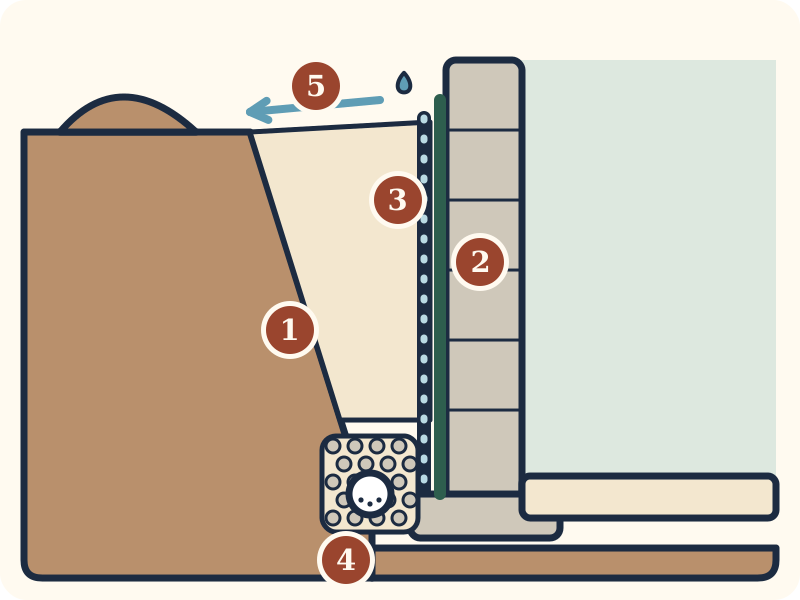
- Excavation. Soil is dug away down to the footing along the wet wall.
- Membrane. The cleaned wall is patched and coated with a waterproof layer.
- Drainage board. A dimpled sheet over the membrane protects it and lets water fall freely.
- Footing drain. Perforated pipe in washed stone at the base carries water to daylight or a pump.
- Backfill and grade. The trench is refilled and the surface shaped to slope away from the house.
What it does to the yard
A trench as deep as the basement runs the length of the wall. Whatever stands in that strip goes: shrubs, mulch beds, a walkway, sometimes steps, a deck post or the pad under an air conditioner. Soil is piled nearby and a small excavator crosses the lawn to reach it.
Ask for the list of what will be removed and what the company will put back. Replanting and paving are often left to you. Fresh backfill settles for months, so the slope beside the wall may need topping up.
Before anyone digs in Roswell
Buried lines. Georgia 811 asks for a dig ticket at least three business days before digging. Utilities mark only their own public lines. Irrigation pipe, the water line from the meter to the house, an invisible pet fence and lines to a septic tank are private and are not marked. Tell the company where yours run.
Trees. The City of Roswell requires a tree removal permit for trees more than three inches across. If a tree stands in the way of the trench, raise it before the start date.
Creeks and flood zones. The city limits work inside stream buffers, and all development in a floodplain needs a local permit. If your lot backs onto a creek, read the Roswell flood zone and drainage guide first.
Ask the company
- How deep will you dig, and how is the trench kept safe while it is open?
- What membrane and drainage board will you use, and how high up the wall do they go?
- Where does the footing drain empty?
- Who files the 811 ticket, and can I see it?
- What is on the list to remove, and what will you reinstate?
- How do you handle settling of the backfill in the first year?
Exterior waterproofing questions
Do all four walls need doing?
Rarely. The wet wall is usually the uphill one. A proposal for every wall should come with a reason for each.
Can it be done in winter?
Coatings have temperature and moisture limits set by their makers. Ask what the product needs and what happens if it rains with the trench open.
Is the black coating the builder applied the same thing?
Usually not. A thin sprayed dampproofing slows moisture. It is not built to bridge cracks or hold back standing water.